


What Are the Symptoms of Perimenopause? Part 2: Hormones, Symptoms & What to Do


In Part 1 of this series, I answered a big question: what is perimenopause? This blog is going one step deeper. If you have ever searched “what are the symptoms of perimenopause?” and wondered how changing periods, brain fog, poor sleep, anxiety, achy joints could possibly be connected, keep reading! Let’s look at what’s actually happening to your hormones during this transition and why it affects so many other parts of your body.
What’s Happening to Your Hormones in Perimenopause?
Perimenopause begins with changes in ovarian function, but estrogen and progesterone interact with systems throughout the whole body, so effects are not confined to changes in your period.
Dr. Lindsey Berkson, who has written several books on hormones, talks about hormones as the email system of our body. Her analogy describes the ease of receiving an email and opening the attachment as well as the dreaded moment when your email goes down, the attachment is missing, or the message comes through without the information you need. I love this analogy because we all live on email and know exactly what it feels like when communication works and when it doesn't.
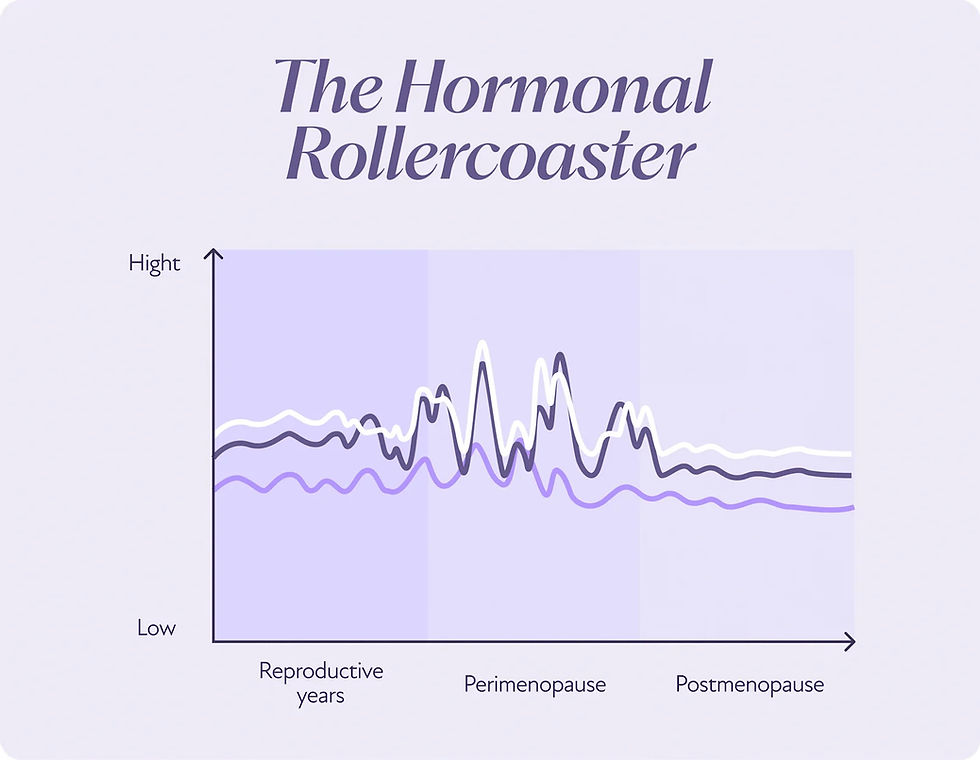
One of the biggest misconceptions about perimenopause is that your estrogen simply starts dropping in a steady linear fashion. If only it were that tidy! Estrogen can fluctuate considerably during the transition, sometimes higher, sometimes lower while ovulation becomes less predictable and progesterone exposure becomes less consistent. Eventually, estrogen levels become consistently lower as ovarian function declines.
You don’t need an endocrinology degree to understand the basic progression:
The ovarian follicle pool declines → communication between the ovaries and brain changes → ovulation becomes less predictable → estrogen becomes more variable → progesterone exposure becomes less consistent.
That’s the hormone story in a nutshell. But perimenopause is a reproductive transition with whole-body effects which brings us to the much more interesting question … why can changing ovarian hormones affect so many seemingly unrelated parts of your body?
Why Perimenopause Symptoms Affect Your Whole Body
I recently listened to an old lecture by Dr. Datis Kharrazian for practitioners on perimenopause. In his seemingly effortless way, he outlined some physiological changes that can occur alongside shifting, fluctuating, and eventually declining hormones. He, and many others, describe perimenopause through a neuroendocrine-immune lens. This immediately widened my understanding!
Neuro-endocrine-immune … meaning the nervous system/brain + endocrine system + immune system are not operating independently, but are constantly communicating with one another. Estrogen interacts with immune, inflammatory, antioxidant, and nervous system signaling. Whoa! Suddenly, some of those seemingly random or disconnected symptoms my clients describe start to make a little more sense. How can one client be experiencing frozen shoulder + insomnia + vaginal dryness at the same time?
Where Estrogen Signaling Matters
Estrogen does a lot more than regulate your period. Let’s look at where estrogen signaling matters.
Brain - mood, cognition, temperature regulation, sleep
Nervous system - pain perception, neurotransmitter signaling
Immune system - inflammatory and immune signaling
Muscle - muscle protein turnover, recovery, function
Bone - bone remodeling and maintenance
Cardiovascular system - vascular function and lipid metabolism
Metabolism - insulin sensitivity, glucose regulation, fat distribution
Genitourinary tissue - vaginal, vulvar and urinary tissue health
Skin/connective tissue - collagen and tissue integrity
The Most Common Symptoms of Perimenopause
AKA, the things women tell me about every day:
Brain and mood: brain fog, anxiety, depression, “I don’t feel like myself”
Sleep and temperature: poor sleep, hot flashes, night sweats
Metabolism and heart: weight gain, suddenly elevated cholesterol
Joints and muscles: achy joints, frozen shoulder
Head: headaches
Sexual and vaginal health: vaginal dryness, painful sex, low libido
Skin: dry skin
Here’s one way I like to think about all of this now that I live in Colorado, where I’m now learning and living with wildfires.
Perimenopause and Inflammation: The Wildfire Analogy
Imagine your body has a series of small controlled fires burning all the time. Inflammation is not inherently bad as we need it for immune defense, tissue repair, exercise adaptation, and healing. In a healthy system, the body is constantly initiating inflammatory responses when they’re needed and resolving them when they’re not. Think of it as a series of “controlled burns”.
Perimenopause is a little like entering a fire season with increasingly unpredictable weather. The fires represent inflammatory activity, the changing weather represents the hormone environment, and the forest represents the many tissues and systems being affected.
Stay with me!

Source: SECO News (2026), Facebook.
Where Hormones Fit
Estrogen may be high one week, low another, or changing rapidly. Progesterone exposure becomes less predictable as ovulation becomes less consistent.
Meanwhile, sleep may deteriorate, body composition can change, metabolic health can shift, and life stress certainly does not disappear.
Now imagine the conditions surrounding those controlled burns keep changing. The temperature changes, the wind changes direction, some stretches are hotter and drier than others. And the forest itself may have other things going on that affect how it responds to the fire.
Hormones aren’t simply the water that puts the fires out. They are better thought of as one part of a much larger fire management system. Estrogen, for example, interacts with inflammatory and immune signaling, but it isn't solely responsible for controlling inflammation.
This distinction is also important when we talk about hormone therapy. Hormone therapy can restore or stabilize an important hormone signal for some women, but hormones are still only one part of a much larger physiological system.
Sleep, metabolic health, physical activity, nutrition, alcohol, visceral adiposity, chronic disease, psychological stress, age, genetics, and other factors can influence inflammatory physiology too.
If a forest is already dealing with drought, high winds, accumulated brush, and multiple active fires, improving one part of the fire-management system can be incredibly helpful, but it doesn't necessarily change every condition in the forest.
Similarly, hormones are one important part of the physiology of perimenopause, but they don’t operate in isolation. Supporting metabolic health, sleep, movement, nutrition, stress regulation, and cardiovascular health still matters even when hormone therapy is part of someone's treatment plan.
How do I know if I’m in perimenopause?
Spend five minutes on Instagram and you’ll almost certainly diagnose yourself with perimenopause. Unfortunately, there isn’t one definitive symptom, a universally accepted checklist, or a single blood test that can tell you, “Yep you’re in perimenopause!”
Instead, we look at the bigger picture: age and life stage + menstrual cycle changes + symptoms + clinical history, along with medical evaluation when appropriate to rule out other possible explanations.
This doesn’t mean the symptoms you’re experiencing aren’t real. Social media has taken a broad range of symptoms that can occur during the menopause transition and turned them into one enormous checklist. The problem is that many of those symptoms can have other causes, too.
Not every woman will experience the same symptoms or experience them with the same intensity. And not every new symptom that shows up in midlife is perimenopause.
What Can I Do About Perimenopause Symptoms?
Firstly, perimenopause isn't something you need to “fix”. It’s not a disease, it's a transition. That doesn't mean you have to white-knickle your way through symptoms either. Some women may choose to explore hormone replacement therapy with their medical provider, in addition to the many diet and lifestyle strategies that can support this transition.
Remember our forest? The goal isn’t to control the weather. It’s to support the health and resilience of the ecosystem as the weather changes. Nutrition, movement, sleep, stress management, metabolic health, and cardiovascular health are all support systems that are being asked to adapt to a changing hormonal environment.
There is a fun term floating around social media right now called “maxxing”, essentially trying to optimize or maximize a particular quality, habit, or activity, sometimes to an almost comical degree.
So, in the spirit of not taking ourselves too seriously, let’s do a little perimenopause-maxxing. Not because you need another impossible wellness checklist. Quite the opposite! These are the boring, foundational things I come back to over and over again with the women I work with.
Maxx your nourishment.
Eat enough. Eat regularly. Prioritize protein. Eat your plants. Get enough fiber and include quality carbohydrates and fats. Nourishment supports muscle and bone, gut health, cardiovascular health, energy, and metabolic health.
And support your blood sugar without becoming obsessed. If you are tired, hungry often, never full, and have cravings, read this blog…Come see me!
Maxx your strength.
Lift weights. Walk. Move your body. Build and protect muscle. Strength training becomes increasingly important for maintaining muscle, bone, metabolic health, physical function, and independence as we age. Everyday movement matters! Walk, hike, dance, carry things, take the stairs, and find movement you actually enjoy.
Maxx your recovery.
Protect your sleep. Get outside and get morning light. Rest. Take the slow walk 1x/week. Have actual days off. Find ways to downshift your nervous system. More exercise, more productivity, and more optimization aren’t always better. Your body needs time and resources to recover and adapt.
Minimize what doesn’t serve you.
Pay attention to alcohol, smoking, chronic under-eating, prolonged sedentary time, chronic over-exercising, and the various other habits (people, environments, and relationships) that consistently leave you feeling worse.
Biggest reminder for all my procrastinators, perfectionists, and everyone in between…none of this has to be perfect, none of this has to wait to start. Perimenopause maxxing isn’t about becoming the world's most optimized 40-something woman. It’s about putting some attention towards YOU, towards the foundational things that help your body navigate a changing hormonal environment.
Kate Costello – MS, CNS, LDN: Kate’s experience with a severe nut allergy inspired her path as a nutritionist and wellness coach. She helps clients rebuild their relationship with food while navigating chronic health challenges, hormonal changes, and digestive issues. Her approach combines science and empathy, focusing on meaningful, lasting transformation through personalized nutrition and lifestyle guidance.
References
Hall JE. Endocrinology of the Menopause. Endocrinol Metab Clin North Am. 2015 Sep;44(3):485-96. doi: 10.1016/j.ecl.2015.05.010. PMID: 26316238; PMCID: PMC6983294.
Nuckols VR, Schwab AI, DuBose LE, Moreau KL, Wenner MM. Menopause and vascular endothelial health: Is it all about the oestrogen? Exp Physiol. 2026 May 30:10.1113/EP092848. doi: 10.1113/EP092848. Epub ahead of print. PMID: 42218087; PMCID: PMC13394117.
O'Connor KA, Ferrell R, Brindle E, Trumble B, Shofer J, Holman DJ, Weinstein M. Progesterone and ovulation across stages of the transition to menopause. Menopause. 2009 Nov-Dec;16(6):1178-87. doi: 10.1097/gme.0b013e3181aa192d. PMID: 19568209; PMCID: PMC2783957.
SECO News. (2026). WatchDuty is currently showing numerous wildfires across Colorado … [Facebook post]. Facebook. Facebook post.
Sükür, Y. E., Kıvançlı, I. B., & Ozmen, B. (2014). Ovarian aging and premature ovarian failure. Journal of the Turkish German Gynecological Association, 15(3), 190–196. https://doi.org/10.5152/jtgga.2014.0022


Comments