


When Does Perimenopause Start - Part 1: What Is Going On With My Body?

When does perimenopause start, and how is it diagnosed?
“Kate, I feel out of control! Nothing in my body is the same. It doesn’t look, feel, or move the same as it did five years ago. After the kids left for school, I was crying while doing the dishes. Then my husband called, and I screamed at him - all within five minutes of each other. What is going on with my body?!”
Those are the words of my client, Claire, this week.
Honestly, I hear some version of this from nearly every 40- to 50-something-year-old woman I work with.
And I get it.
I’m 38, and lately I feel like I’m standing at the edge of perimenopause, staring at a wildfire and wondering when the wind is going to shift in my direction.
When will this start for me? Has it already? What does the research actually say about when perimenopause begins? Which symptoms are really associated with it?
I find myself hyperanalyzing anything that happens on a given day…
I didn’t sleep well last night.
My rib was out of place when I woke up.
I have what feels like a UTI.
I’m irritable.
My period is coming, but my cycle is longer this month.
Is this just being 38?
Is it normal hormonal variation?
Is it stress?
Or is it perimenopause?!
If you’ve found yourself asking the same questions, you’re in the right place.
Before we talk about how to eat, exercise, supplement, or otherwise support ourselves through perimenopause, we need to start with a surprisingly complicated question:
What actually is perimenopause?
What is perimenopause?
Perimenopause is having a moment online - and thankfully!
Women are talking about their symptoms. Practitioners are talking about women’s health. We’re finally having conversations that probably should have been happening for decades.
That said, social media also has a way of taking health information out of context. Culturally, we also love to hyperfixate on one health topic and then fear-monger ourselves straight into overwhelm.
Hello, fad diets and 2025: the year of protein and peptide stacks!
I’m stoked we’re talking about perimenopause. I also want us to understand what it actually is.
So, let’s get some definitions straight.
The following are paraphrased from the European Society of Endocrinology clinical practice guidelines for the evaluation and management of menopause and perimenopause.
Perimenopause
The transitional years surrounding menopause, when ovarian function and reproductive hormones begin to change. Your periods may become less predictable, and symptoms can begin during this time. Perimenopause can last several years.
Early menopause
Menopause that occurs between ages 40 and 44.
Menopause
Menopause is confirmed 12 months after your final menstrual period.
The tricky part? We don’t actually know that a period was your final period until you’ve gone 12 consecutive months without another one (assuming your periods haven’t stopped for another reason).
The average age of natural menopause is 51.
Premature Ovarian Insufficiency (POI)
A significant loss or disruption of ovarian function before age 40.
Unlike typical perimenopause, POI warrants specific medical evaluation and has important implications for long-term health.
Very simply, the timeline looks something like this:
Reproductive years → Perimenopause → Final menstrual period → 12 months later → Menopause is confirmed → Postmenopause
And yes, it’s much more complicated than this!
You can absolutely be in perimenopause while still having periods. In fact, menstrual cycles can remain surprisingly regular early in the process.
As the transition progresses, cycles typically become increasingly variable.
The STRAW+10 staging criteria uses changes in menstrual bleeding patterns as its primary criteria for identifying the early and late menopause transition.
Perimenopause isn't a neat, linear hormonal transition
This is one of the most important things to understand.
Perimenopause is not simply a smooth downward slope where estrogen gets lower and lower every year.
When you look at graphs in the research showing individual women’s hormones throughout perimenopause, they can look more like Etch A Sketch art than a nice, tidy line.
Estrogen can spike and fluctuate. Ovulation can become less predictable. Hormone levels can change from month to month - and sometimes even more dramatically than that.
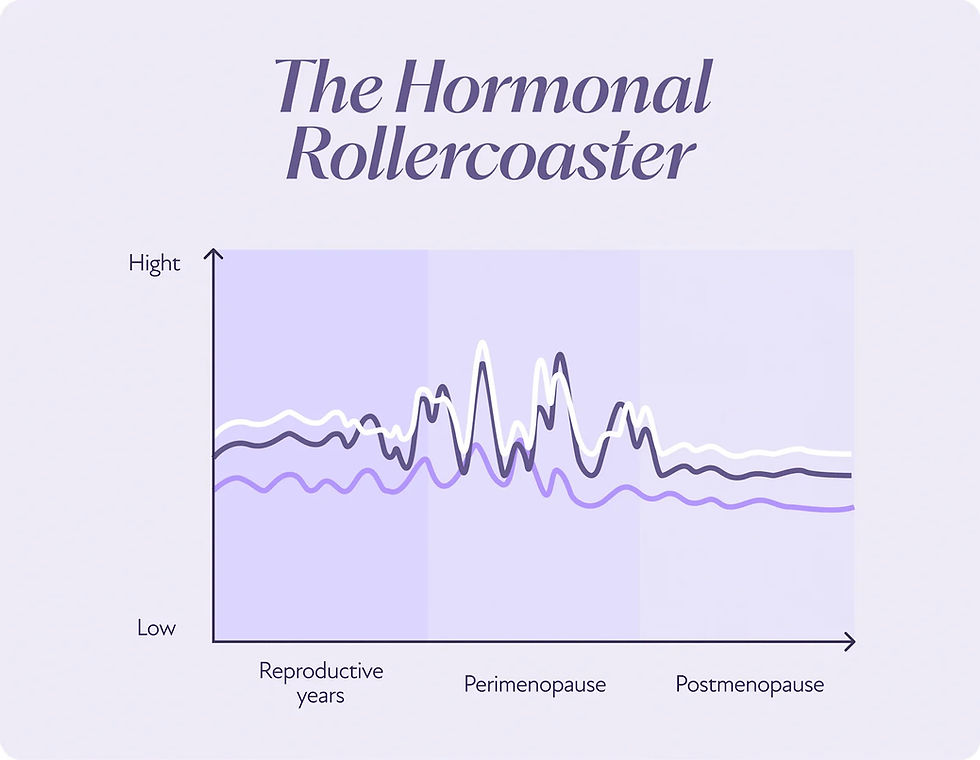
[Figure: From Perimenopause: Recognizing the First Signs of Menopause, by Winona, 2026.]
This hormonal unpredictability is part of what makes perimenopause so confusing.
You may still be menstruating.
You may have months that feel completely normal.
Then suddenly your cycle is eight days longer, you’re awake at 3 a.m., and you’re crying because the grocery store is out of your favorite yogurt.
So…
When does all of this actually start?
When does perimenopause start?
Everyone would like to know!
There isn’t one birthday when the switch flips, although that’s exactly how many of my clients describe it. Perimenopause unfolds in phases, with shifts that can initially be subtle enough to make you wonder if you’re imagining them.
Perimenopause most commonly begins in the 40s, often around the mid-40s, but the timing varies considerably from woman to woman.
Researchers actually stage the menopause transition - another term for perimenopause - primarily by looking at changes in the menstrual cycle, rather than simply looking at someone’s age or measuring a single hormone level.
In 2001, and later revised in 2011, scientists from five countries and multiple disciplines developed the STRAW+10 (Stages of Reproductive Aging Workshop +10) criteria.
STRAW+10 provides a framework for understanding reproductive aging, from the late reproductive years through the menopause transition and into postmenopause (Harlow et al., 2012).
Perhaps another blog will look at STRAW+10 alongside symptoms.
For now, the important takeaway is this:
Your age can give us context, but your menstrual cycle gives us important information about where you may be in the transition.
The Menopause Society highlighted a study titled “Exploring prevalence and drivers of perimenopause uncertainty among US women: a mixed-methods study.”
The study included more than 7,600 women age 35 and older.
Overall, 34% of participants reported being unsure of their reproductive stage. That uncertainty varied by age and symptom severity, peaking at 42% among women ages 40 to 44 and 37% among those with severe symptom burden.
Honestly, this makes so much sense!
Part of what makes perimenopause so hard to recognize is that it arrives during an already very full season of a woman’s life.
Maybe you’re not sleeping because work is crazy busy.
Your body composition changed, but it was summer and your routines were different.
You’re more irritable, but your teen is teen’ing.
Your parents need more help.
Your career is demanding.
Your relationship is changing.
You’re just trying to keep 47 tabs open in your brain at all times.
It can be surprisingly difficult to separate what’s life and what’s perimenopause.
Life be life’in!

[Figure: Stages of Reproductive Aging Workshop +10 staging system. Note. From “Executive Summary of the Stages of Reproductive Aging Workshop +10,” by S. D. Harlow et al., 2012, Menopause, 19(4), 387–395.]
How is perimenopause diagnosed?
According to Mayo Clinic, there is no single test or symptom that can definitively tell you that you’ve entered perimenopause.
Instead, your healthcare provider looks at the bigger picture:
your age
your menstrual history
your symptoms
and the changes you’re noticing in your body
Ugh. Not exactly the clear-cut answer I was hoping for!
Perimenopause is primarily a clinical diagnosis, not a lab diagnosis. Hormones like FSH and estrogen can fluctuate considerably during this phase. That means a blood test showing your hormone levels on one particular day isn’t always especially helpful.
Why? Because perimenopause is a transition.
Depending on your age, symptoms, and clinical history, your healthcare provider may order testing to rule out other causes or better understand what is going on.
Your menstrual cycle is constantly giving you information.
Tracking changes in cycle length and bleeding patterns alongside symptoms such as hot flashes, night sweats, sleep changes, mood changes, vaginal or urinary symptoms, and others can help your practitioner see the bigger picture.
Mayo Clinic strongly recommends keeping a record of your cycles and symptoms when preparing to discuss perimenopause with your healthcare provider.
We, as your nutritionists, recommend that too!
So…am I in perimenopause?
Maybe.
Maybe not.
And that’s part of the frustrating answer.
There isn’t a single age, symptom, or blood test that gives everyone a definitive “YOU ARE HERE” moment.
Instead, perimenopause is a process. Your cycles, symptoms, age, and overall health history all help paint the picture.
And if you’re sitting there thinking, Okay, but what is actually happening to my hormones? And why does it feel like everything is suddenly connected to everything else?
You’re asking exactly the right question.
In Part 2, we’ll look at what is actually happening to your hormones during perimenopause - and why those hormonal shifts can create such a wide range of seemingly unrelated symptoms.
Feeling stuck or overwhelmed? Let’s chat! Book a free 20-minute call and we’ll figure out what really works for you.
References
Harlow SD, Gass M, Hall JE, Lobo R, Maki P, Rebar RW, Sherman S, Sluss PM, de Villiers TJ; STRAW 10 Collaborative Group. Executive summary of the Stages of Reproductive Aging Workshop + 10: addressing the unfinished agenda of staging reproductive aging. Menopause. 2012 Apr;19(4):387-95. doi: 10.1097/gme.0b013e31824d8f40. PMID: 22343510; PMCID: PMC3340903.
Mary Ann Lumsden, Olaf M Dekkers, Stephanie S Faubion, Angelica Lindén Hirschberg, Channa N Jayasena, Irene Lambrinoudaki, Yvonne Louwers, JoAnn V Pinkerton, Antoan Stefan Sojat, Leonie van Hulsteijn, European Society of Endocrinology clinical practice guideline for evaluation and management of menopause and the perimenopause, European Journal of Endocrinology, Volume 193, Issue 4, October 2025, Pages G49–G81, https://doi.org/10.1093/ejendo/lvaf206
Mayo Clinic. (2026, August 22). Perimenopause: Diagnosis and treatment. Retrieved September 19, 2026, from Mayo Clinic
Sükür YE, Kıvançlı IB, Ozmen B. Ovarian aging and premature ovarian failure. J Turk Ger Gynecol Assoc. 2014 Aug 8;15(3):190-6. doi: 10.5152/jtgga.2014.0022. PMID: 25317048; PMCID: PMC4195330.
Winona. (2026). Perimenopause: Recognizing the first signs of menopause. https://bywinona.com/perimenopause


Comments